Showing posts with label abertay university. Show all posts

Monday, 2 December 2013

Case Studies - Vector Art

Farmville

Developer: Zynga

Platform: Facebook

Genre: Simulator/Social game/Casual

Age Rating: E


Farmville is a farming simulator social game for Facebook, developed by Zynga.  The player must manage a farm by means of plowing, planting, growing, harvesting crops and trees and raising live stock.


It's a freemium game and until May 2012 was the most popular game on Facebook.  The player can invite Facebook friends to become neighbours which allows them to interact with them in game via visiting each others farms and giving gifts and supplies.  The vector art style used feels, in my opinion, quite generic however, as the main audience appears to be casual gamers, perhaps this is simply an accessible art style that audiences will neither love or loathe? 


Candy Crush Saga

Developer: King

Platform:  Facebook, Android

Genre: Puzzle/Casual

Age Rating: E
Candy Crush Saga is a casual puzzle game for Facebook and Android devices, developed by King which is a variation of their browser game Candy Crush.  A "match three" type of puzzle game, players must swap different coloured candies either horizontally or vertically on a board in order to create sets of the two or three same coloured candies.  


Another freemium casual game, players must unlock or pay to access certain levels.  This game also uses vector art and has experienced explosive popularity with casual gamers.  Perhaps its success in the casual market was also partly due to its generic style?

Moshi Monsters

Developer:  Mind Candy

Platform: Online

Genre: Simulator/Puzzle

Age Rating: E (Target audience 6-14)


Moshi Monsters is a children's website where players can choose from six virtual pet monsters that they can name and nurture.  They can then travel around the online world of "Monstro City," chat to other users and play mini games in order to gain fictional currency to personalise their rooms.


It has a cute, colourful art style that is very appealing to children.  As the game's main appeal is the characters and visual experience, this art style may have been a large factor in its popularity (the game has over 80 million registered users.)


Outernauts

Developer:  Insomniac Games

Platform:  Facebook

Genre:  Social RPG

Age Rating:  3+


Outernauts is a social RPG developed by Insomniac Games (famous for the Spyro and Ratchet and Clank franchises) for Facebook.  Players must explore planets and capture alien creatures to battle with in a similar fashion, gameplay wise, to Pokemon.  


The art assets are a brilliant example of stylised vector graphics, with Dave Guertin and Greg Baldwin's styles shining through the artwork.  Interestingly, the developers wanted the game to attract both casual gamers and core gamers, however critics claimed the freemium "pay to win" mechanics would put core gamers off. (Davidson, P. 2012)


Shank

Developer:  Klei Entertainment

Platforms:  PC, XBLA, PSN

Genre:  Side scrolling beat em' up

Age Rating:  18+


Shank is a 2D side-scroller beat em' up by Klei Entertainment.  In this story based game, the player takes on the persona of Shank, an ex-hitman out for revenge for the murder of his girlfriend.


The animation was done in Flash and the art style took influence from cartoons, the golden age of comic books and graphic novels. (Cheng, J.  2010 quoted in Graft, K, 2010)  Perhaps the developers chose to utilise vector animation due to the general benefits of vector over raster graphics-  Vectors are made up of mathematics (as opposed to pixels) so they generally take up less file space than raster graphics and, for the same reason, they do not lose quality when scaled up or down.


To conclude, generic vector art is a style favoured by games targeting casual gamers as it is a safe and accessible art style.  Colourful, clean, simple shapes are also appealing to children.  Finally many artists prefer vector graphics to raster graphics as they take up less memory and there is no loss of quality when the vector image is re-sized.


Case Studies - Cel Shaded Games

Plants Vs Zombies
Developer:  PopCap Games


Genre:  Tower Defence


Platforms: PC, XBLA and iOS.
Age Rating:  E


Plants Vs Zombies is a tower defence game by PopCap Games where the player takes on the persona of a homeowner under the attack of an army of zombies and has to utilise a variety of plants in order to repel them.


Firstly its worth noting that, as far as I can tell, the art assets for this game were created using a mixture of both vector and cel shaded art.  The environments and menu screens all seem the be cel-shaded, with characters designed using vectors in a cel shaded like style.  The developers aimed for the art style to be a balance of “gritty” and “sickeningly cute.”  They aimed to target more experienced players by including strong strategic elements and more casual gamers by keeping the rest of the game relatively simple with few tutorials. (Thomson, M. 2010) 

Perhaps the art style has been used to reflect this – The friendly cel shaded art style mixed with the tongue-in-cheek goulish subject matter?


BattleBlock Theater
Developer:  The Behemoth

Genre:  Platformer

Platform: XBLA

Age Rating:  12 +


BattleBlock Theatre is a platformer game by The Behemoth developed for Xbox Live Arcade.  After the S.S. Friendship becomes shipwrecked, the entire crew, including the player, is taken captive by technologically advanced, highly intelligent cats and forced in to deadly theatre performances where the player must fight for survivor.  


The game is highly story based, with humour being a main selling point.  It is also a challenging game with a high diffiuclty level however it is worth noting that the bright colours and friendly, simple shapes alongside cut-scenes told in a puppet theater like fashion may be very appealing to children.  Furthermore, the game also includes a highly acclaimed co-op mode and several other modes of play such as the "Capture The Flag" based "Capture The Horse" and competitive trial run modes so there's "something for everyone."  (Carter, C.  2013)


Another game with a cartoony cel shade art style designed with a wide target audience in mind.


Skullgirls

Developer:  Reverge Labs/Lab Zero Games

Platforms:  PS3, Xbox 360, PC

Genre:  Fighting

Age Rating:  13+


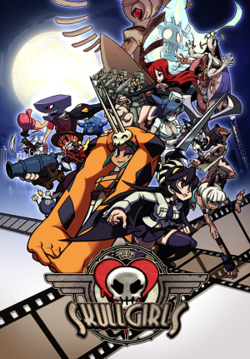
Skullgirls is a 2D fighting game by Reverge Labs and co-published by Konami and Autumn Games.  It is set in a fictional world featuring 8 playable female characters fighting to obtain the "Skull Heart" which according to the game's lore has the ability to grant any woman's wish.


Whether you're in to the whole anime style or not, it's a beautiful game with some of the best game animation I've ever seen.  According to the fantastic video below on how the artists tackled animating the characters for this game, "each character animation is hand drawn and between 1200 to 1500 frames."  A crazy amount of time and effort was put in to this game animation and undoubtedly the same effect would not have been achieved if they'd used another art style such as pixel or vector art.


Although it's quite pixel art-like as the first game was released in 1994 by Capcom, the 2D fighting game Darkstalkers also helps illustrate this point as there is an evident cel shading style used in the character art and the animation portays brilliant use of Disney's acclaimed 12 principles.  (Lee, R. 2010)


To conclude, cel shading is often used in games designed to attract a varied audience which is likely due to the appealing child friendly cartoon style. It is also appears to be a style preferred by games that require complex animation as this style is less time consuming than a more painterly style, yet still allows for fluid animation.


Sunday, 10 November 2013

Art Tests

Cel Shaded

Painterly

Pixel

Vector
Really basic mock screen shots for a (super basic looking) jungle themed platformer. 

The Cube Test


So I thought I'd start simple.

For the cel-shaded style cube I used this tutorial by Lizzy Dawson, for the pixel art I looked in to these tutorials and, as I'd never used Illustrator before, I did the Illustrator for Beginners tutorial on digitaltutors.com for the vector cube.

Art Style Mood Boards


Project Introduction

"What methods are used to create polished art assets for 2D games and why?"

What methods are used to create polished artwork for 2D games?   

I will be looking in to the creation of art assets for 2D computer games and the art pipelines and methods used to achieve the standards expected in industry. 

I will explore different art styles applied to games (i.e. pixel, vector, cel-shaded, painterly art) and why they are used.  For instance, which art styles tend to be used for certain target audiences and why? 

Project Aim

To demonstrate my research I will create several mock screenshots for a game concept, in the style I find the most effective.   These will be still images however will be accompanied by a style guide and fully developed in game assets (such as HUD designs and power ups.)

By the end of the year I aim to have improved my general 2D art skills and widened my artistic ability.  In particular I want to portray a versatile art style that can be changed to meet the needs of a project.